Savitsky Planing Boat Calculations (English
Units)
Description:
This template performs Savitsky planing boat powering
calculations. This Savitsky method is a
simple but comprehensive hydrodynamic planing boat power prediction
method. This template also checks the results to
see if porpoising instability will be a problem.
Five input speeds are evaluated and the power and trim angle results are
automatically plotted on output charts. The effects of the placement
of the vessel's longitudinal center of gravity, LCG, are also computed.
For user experiences with this boilerplate Excel
spreadsheet, see the
customer comments page.
These calculations are for smooth water performance and
are based on procedures for Savitsky's Long and Short Forms that are
contained in Reference A. This template is presently available only
in English units. The effects of slow speed non planing operation,
extra powering required for seaway effects, trim tabs, appendage
resistance, air resistance are not computed. Reference B may be
utilized to do these additional calculations.
There are advantages and benefits to this calculative
method. First this approach saves time. Hundreds of
computations are quickly done behind the scenes on your input data.
Hours of time are saved since the data does not have to be entered over
and over again into the hydrodynamic, iteration and interpolation
formulas. Second this approach provides clear and neat
documentation. Theses computations can readily be submitted to U. S.
C. G. or classification societies if requested. Third this approach
is cost effective because the calculative approach is already developed
for you, research time is minimized to familiarization of concepts when
necessary and not to time consuming development activities.
This Savitsky planing boat template contains no Excel
macros and there is no Visual Basic code utilized in it's creation.
Also advanced Excel features such "Goal Seek," "Solver" and "Scenarios"
were not used. Simply change a value in the spreadsheet and it
automatically and immediately recalculates all affected values.
Electronic
Document Type: Microsoft Excel
spreadsheet
Cost: $75 US funds
Number of
Pages: Inputs Sheet 2 pages, Summary Sheet 1 page,
Speed calculation sheets 5 pages, Input/Output checks 10 pages, Iteration
and Interpolation sheets 5 pages, References
and Figures 3 pages, Bottom Speeds 1 page, Porpoising 1 Page, Use Terms 1
page, Instructions 1 page. Generally only 8
pages are needed for submittal. The other 22 pages are required for
additional computations, checks or they are instructional in nature.
Inputs:
-
Two input speeds, knots. From these two
speed the results for five speeds are automatically calculated, these
two speeds simply define the upper and lower limits of the speed range
evaluated. However, the user may override the automatic
intermediary speeds & calculate five user specified speeds if desired.
-
For each speed, two iteration trim angles (upper
and lower) are allowed as optional inputs. Default values are used
if iteration trim angle values are not specified. These default
values are normally satisfactory.
-
The calculative method needs to be specified.
Simply specify the value of "one" for Savitsky Long Form calculations
and set to the value of "two" for Savitsky Short Form computations.
-
Hull characteristics
-
Length Over All, LOA, feet (optional input)
-
Length of Waterline, LWL, or Chine Length, feet
-
Beam on Waterline, BWL, feet (optional input)
-
Exit Angle, qAFT,
of Aft Quarter Butt, an explanatory diagram is provided with this
template. This value is critical for proper operation and is
therefore checked in this analysis. For more details about this
requirement refer to Pages 12 and 13 of Reference D.
-
Deadrise angle, b,
degrees, for vessels with variable deadrise, pages 93 and 94 of
Reference A, suggests using the value at the stagnation line.
The stagnation line is shown in the first figure contained in the
Reference portion of this spread sheet.
-
Chine beam, b, feet, this is a critical
value. For vessels with variable deadrise, pages 93 and 94 of
Reference A, suggests utilizing the value at the stagnation line.
-
Weight information
-
Vessel light ship weight, pounds, without any
people, luggage, personal gear, provisions, stores, fluids or cargo on
board
-
Weight margin on light ship, percent. This
is optional input, default values are provided.
-
Cargo weight, pounds, can be left at zero default
value. This would include the weight of fish and ice if
applicable.
-
Number of crew and number of passengers,
integer
-
Additional equipment not included in light ship,
pounds
-
Duration of voyage, days, for calculating
provisions and stores, can be set equal to zero
-
Personal crew gear and passenger luggage,
pounds, can be set to zero
-
Portions of total fluid capacities to be
applied in analysis, default values usually 2/3 are provided,
however these values may be specified as inputs.
-
Main propulsion engine tank capacity, gallons, and
fuel type (diesel or gasoline). This is a highly recommended input
value, if provided an estimate of the vessel's range is automatically
computed by this spreadsheet.
-
Auxiliary fuel tank capacity, gallons, and fuel
type (diesel or gasoline)
-
Potable water tank capacity, gallons
-
Sewage holding tank capacity, gallons
-
Longitudinal center of gravity, feet, distance
forward of transom to center of total weight present. Initially
this value may be estimated. Weights may need to be rearranged
change this value in order to get proper optimal planing boat
performance.
-
Vertical center of gravity, feet, distance above
hull bottom to center of total weight present. Initially this
value may be estimated. (Required for Savitsky Long Form
calculations.)
-
Propulsion Plant Details:
-
Installed brake horsepower
-
Parasitic loads, horsepower, for pumps,
generators etc.
-
Continuous operating rpm, percentage, guideline
values are given on the input sheet, simply select the applicable rpm
percentage
-
Propeller Shaft Angle,
e, degrees (required only for Savitsky Long
Form calculations for Savitsky Short Form computations set this equal
to zero)
-
Thrust moment arm, f, feet, perpendicular
distance off shaft line to vessel's center of gravity. (Required
only for Savitsky Long Form calculations for Savitsky Short Form
computations set this equal to zero.)
-
Shafting efficiency, ratio, guideline values
given, select appropriate value
-
Propeller efficiency, ratio, a default value is
present, however another value may be utilized for the calculations
-
Vessel range required, nautical miles, optional
input. If this value is specified this spreadsheet will
automatically determine if tanks provided are adequate to make the
voyage distance specified by this input.
-
Properties of water (fresh or salt) that the
vessel is operating in:
-
mass density (Slugs/Ft3)
and kinematic viscosity (Ft2/Sec)
-
values are provided on the input sheet, simply select
the applicable operating temperature and insert values associated with
this operating temperature and the operational water type (FW or SW).
Intermediate values may be interpolated or Reference G may be
consulted.
Outputs:
-
For each of the five input speeds the following is
output for equilibrium conditions computed by this template:
-
Checks for porpoising instability
-
The input and output range of data is checked for
applicability as per the limits of the hydrodynamic modeling data
utilized. For details see Reference A.
-
The total operational weight is automatically
computed based on light ship margin selected, cargo present, persons
aboard, voyage duration which affects stores and provisions, selected
operational tank capacities and gear on board.
-
Supplemental values like the weight density of the
water, displacement length ratio, estimated maximum possible
displacement speed, speed length ratios, volumetric Froude numbers,
equilibrium wetted length beam ratios, equilibrium drafts to keel and a
lot of other intermediary values are also computed to obtain the
equilibrium values for trim angles and drag forces.
Recommended
Reading:
Reference A: Daniel Savitsky, "Hydrodynamic
Design of Planing Hulls," Marine Technology, October 1964 Issue,
SNAME, Paramus, NJ -
Reference B: Daniel Savitsky and P. Ward Brown,
"Procedures for Hydrodynamic Evaluation of Planing Hulls in Smooth
and Rough Water," Marine Technology, October 1976 Issue, SNAME,
Paramus, NJ
-
Reference C: Daniel Savitsky, "Chapter IV
Planning Craft of Modern Ships and Craft," Naval Engineers Journal,
Feb. 1985, Special Edition, American Society of Naval Engineers,
Alexandra, VA
-
Reference D: Dave Gerr, Propeller Handbook,
International Marine, 1989, Camden, Maine.
-
Reference E: Dave Gerr, Nature of Boats,
International Marine, 1995, Camden, Maine.
-
Reference F: Joseph G. Koeble, Jr., "Performance
Prediction Chapter," No. 120 Small Craft Engineering Resistance,
Propulsion and Seakeeping, Reprinted Oct. 1975, University of Michigan,
Ann Arbor, MI.
-
Reference G: J. B. Hadler, "Coefficients for
International Towing Tank Conference 1957 Model-Ship Correlation Line,"
Report 1185, April 1958
-
Reference H: Alfred D. Isaacson, paper entitled "Sewage
Pollution Control: A Guide for the Ship Owner & Design," SNAME
Marine Technology, July 1977 issue.
-
Reference I: S9086-C6-STM-010/CH-096R1 "Naval
Ships' Technical Manual Chapter 096 Weights & Stability," NAVSEA, 2
August 1996.
Terms:
Prior to purchase, read our
End User License Terms.
Important Notice to European Union Buyers:
Due to changes in international law, we
no longer accept purchases from any individuals located
within an EU country. However, businesses located
within the EU are allowed to make purchases, provided that they make
the VAT payments for any imported items purchased electronically.
These EU businesses must specify their VAT number in the memo
section on the Paypal payment pages. These changes are
effective as of July 1, 2008, and were modified for EU businesses on
April 9, 2010.
Download Now: click the following hyperlink to pay $75 fee and then
immediately download the zip file containing the template.
Minimum System Requirements: Windows 95/98/NT/2000/XP/Vista/Windows7
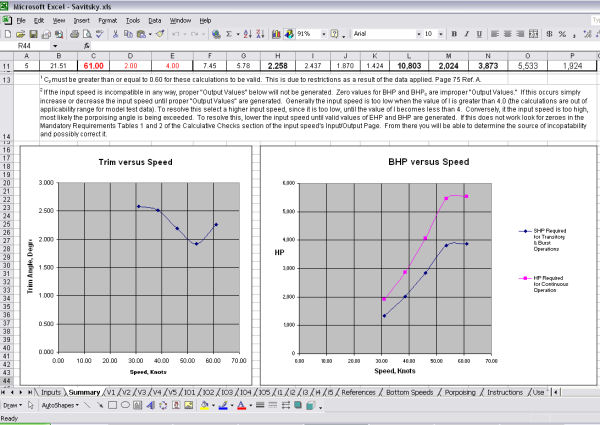
Sample: A sample of an output page is shown below.
|